01
What an LLM does well
A large language model can interpret instructions, analyse supplied information, draft plans, and generate useful recommendations from the context it can currently see.
The Framework
Intelligence as structure in motion.
ToM (Tree of Mind) is a governed AI architecture around the language model. It brings approved context, evidence, and configured rules into decisions while keeping human authority outside the model.
Why structure matters
The question is not only whether an AI system can produce an answer. It is whether that answer remains stable, coherent, and traceable under load.
Consider the tree. A tree that never feels the wind grows hollow. Strength comes from measured resistance, from developing more resilient structure in response to real challenge.
This is the inspiration behind ToM's approach to bounded adaptation. Operational evidence can inform reviewable calibration over time; exposure alone does not guarantee improvement.
The aim is not autonomous maturation or perfect correctness. ToM is designed to preserve governed state, detect drift, and support bounded adjustment when evidence and authority permit.
Conceptual architecture
Connected context enters an Observe, Interpret, Decide, Act, and Retain loop before a recommendation or permitted action reaches an inspectable outcome. The language model contributes reasoning inside that system; it is not the system's source of authority.
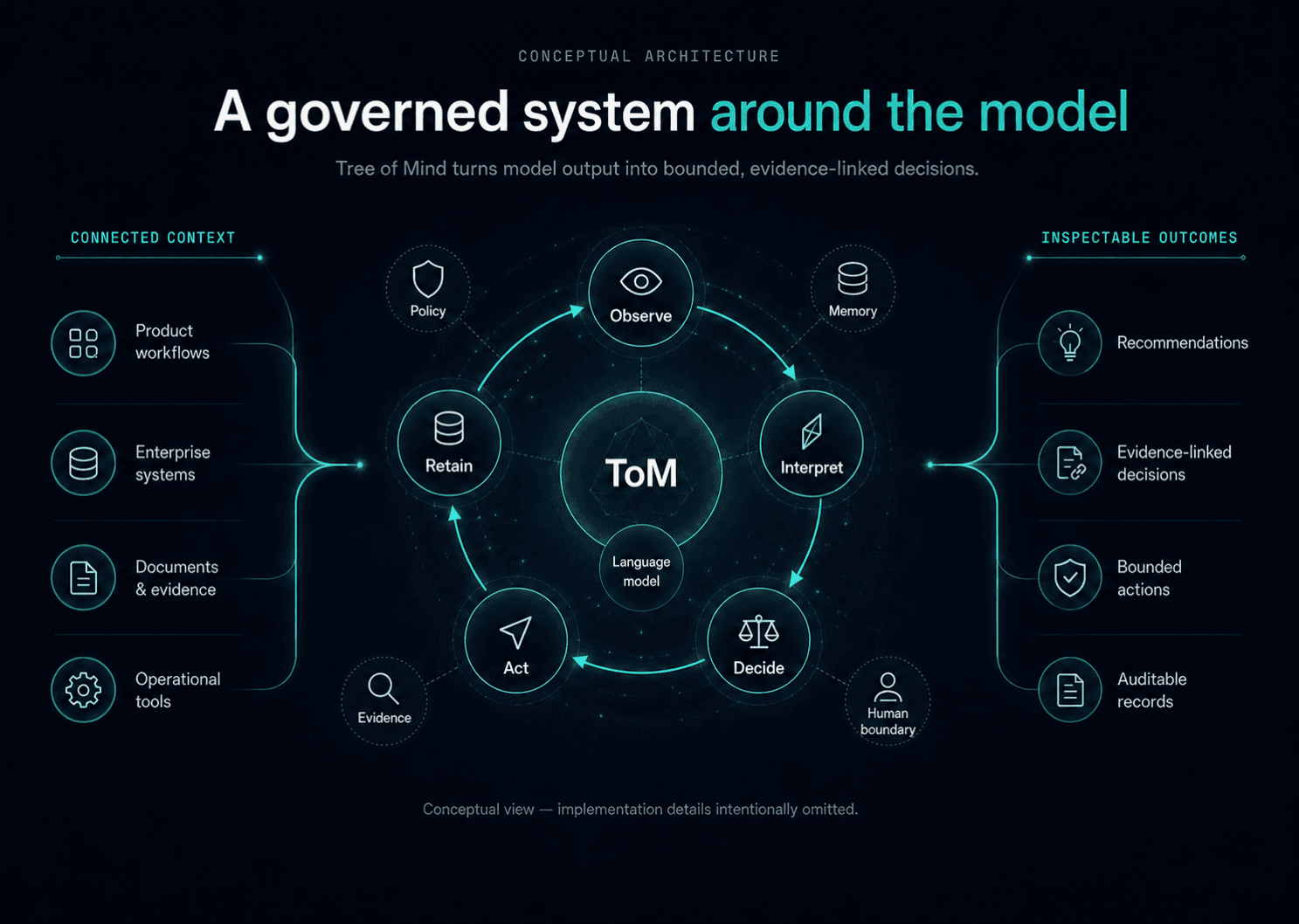
Connected context
Governed loop
Observe · Interpret · Decide · Act · Retain, with policy, memory, evidence, and human boundaries around the language model.
Inspectable outcomes
Conceptual architecture: this simplified view is not a runtime trace or performance claim. Implementation details intentionally omitted.
Stage explorer
Use the stage explorer to read each part of the loop while the complete system map remains visible above.
Interpret
A configured language model can help interpret the available context, but it remains one component inside the governed system.
Model output is treated as a proposal, not as permission to act.
Language model + ToM
Modern language models are trained on vast bodies of text and can produce capable analysis. The remaining problem is how context, evidence, permission, and consequence are managed when that analysis enters a real workflow.
01
A large language model can interpret instructions, analyse supplied information, draft plans, and generate useful recommendations from the context it can currently see.
02
ToM builds the governed path: approved context, available evidence, configured rules, memory boundaries, action limits, and explicit authority.
03
The recommendation can be released, constrained, held, or escalated through a separate configured decision path, with a record available for authorised review where supported.
Key principles
The five-stage orbit shows how a decision moves. These principles describe what governs the boundaries around that movement.
01
Context, evidence, memory, and product integrations remain subject to the permissions and handling rules of the active system boundary.
02
Configured decision paths are designed to retain the evidence, authority, and rationale needed for authorised review.
03
Permitted evidence may be retained after provenance, policy, and reflection checks rather than treating every interaction as memory.
04
Initiative remains controlled, never unlimited. ToM is designed to support adaptation without silently exceeding the configured mandate.
Public architecture view: the orbit explains how connected context moves through a governed decision cycle. It is conceptual and intentionally omits proprietary runtime topology.
Understand the framework
Runtime governance and persistent memory answer different questions within ToM. These guides connect each subject to a practical workflow, the published research and the evidence needed for an integration.
Assess a proposed action against current evidence, operating limits and the authority to proceed. Work through a changed document release and the questions to test at the execution boundary.
Read the runtime governance guidePreserve objectives, decisions and source references across extended work. Explore context drift, stale evidence and a session handoff that can be checked against the current task.
Read the persistent memory guideWhy it matters now
Models are becoming more capable and more interchangeable. The enterprise bottleneck is no longer just generating an answer. It is preserving context across extended work, governing access to core systems, and reviewing recommendations before they create financial, operational, or safety consequences.
ToM is not a prompt wrapper or another agent toolkit. It is the cognitive-control architecture around models, agents, and workflows, designed to make context, authority, evidence, and outcomes more inspectable. As models commoditise, this surrounding architecture is where durable differentiation and accountable action move.
Proposal is not permission
A persuasive model output must not be able to override a safety, policy, or authority boundary through language alone. ToM keeps selected release decisions in a separate configured path, where evidence, limits, and human authority, not model confidence, determine what may proceed.
Language model
ToM
Conceptual outcome model: product integrations may support different configured outcomes and authority paths. These four responses describe the governance proposition, not a guarantee that every intervention is operationally optimal.
Inspect the evidence
Separate research examines structured reasoning, long-context continuity, and governed release in a bounded embodied-action simulation.
See industry applications
Spinal robotic navigation, autonomous mine haulage, integrated air defence, and bushfire grid restoration make proposal, permission, and consequence visible.
Put the Framework to work
Talk with us about ToM, an enterprise product, a governed evaluation, research, or strategic partnership.