Air and drone-defence decision intelligence

ToM Defense Resolution

Operator-supervised decision automation for complex air and drone-defence scenarios.

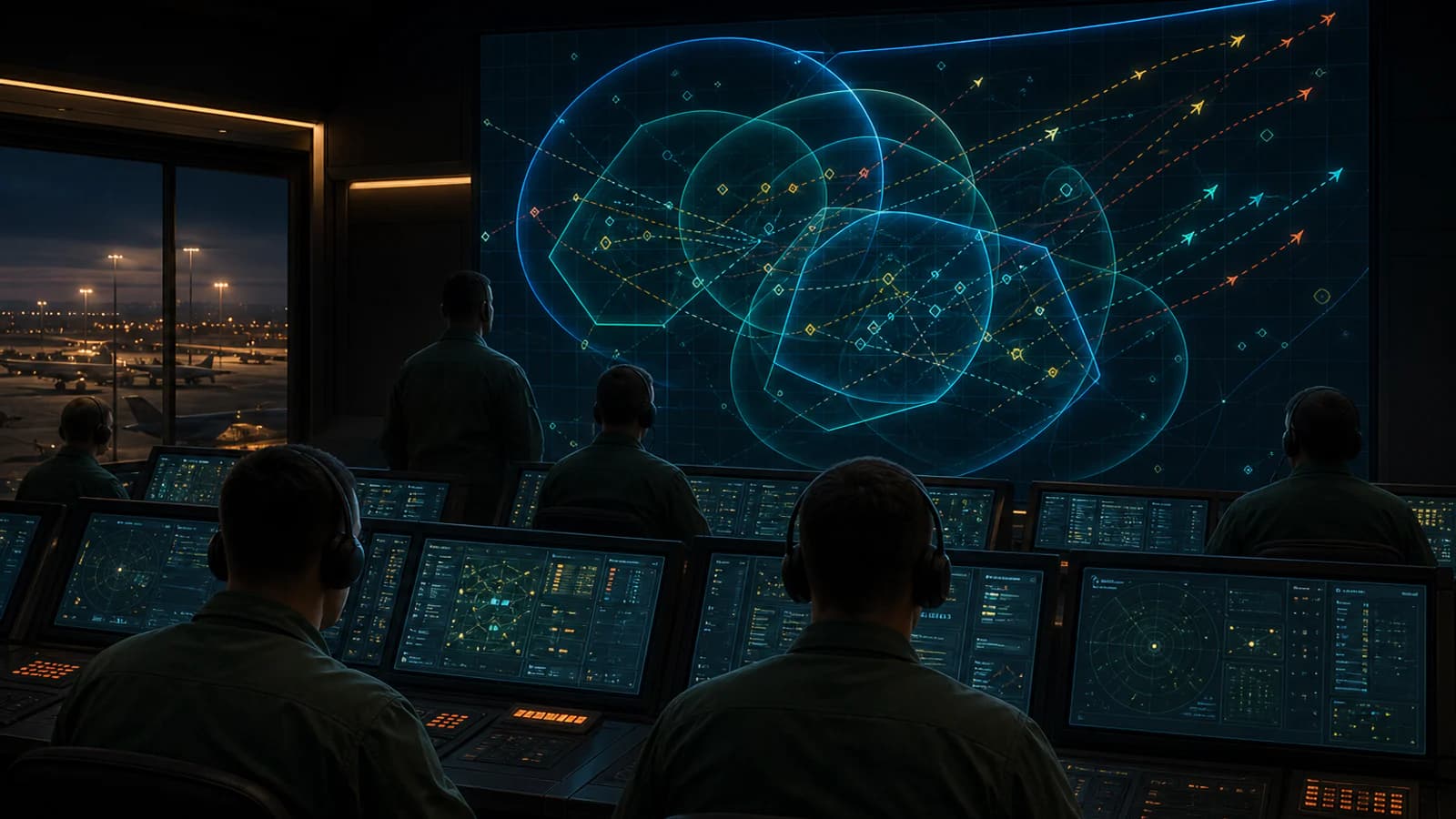
Illustrated fictional air-defence operations centre where operators supervise a shared multi-track air picture.
Illustrated air-defence operations environment · fictional multi-track scenario

Resolution combines simulated radar and sensor observations with uncertain air tracks, protected-site priorities, available sensors, warning channels, site-posture and infrastructure controls, and declared mission priorities. ToM runs an isolated synthetic projection for every permitted response and for no action, then selects one protective action, holds or blocks when evidence or scenario authority is insufficient.

  • Multi-sensor air picture
  • Protected-site priorities
  • Response and no-action projections
  • Select, hold or block

Air-defence decision workspace

The complete ToM loop, from situation to reviewed experience.

Resolution's competitive advantage is the complete ToM decision loop. It connects the developing situation, projected consequences, mission priorities, authority constraints, selected action, observed outcome and reviewed experience. Operators can follow why a decision was made, what happened and how that experience informs subsequent decisions.

Resolution provides the decision layer inside a control-centre-style scenario environment. Air-surveillance operators supervise the air picture, protected-site priorities, sensor condition, declared mission priorities, scenario authority, selected action, projected outcome and observed result. The current product evaluates and executes that decision inside its synthetic environment; operational command-and-control and field execution remain a separate integration boundary.

Protected priorities can include personnel areas, medical facilities, power and water, communications, transport access and emergency services. Available response capacity can include sensor attention, corroborating observations, warning channels, site posture, infrastructure controls, communications, time and operator capacity.

One recorded decision · synthetic scenario

Follow the decision from evidence to result.

Evidence

A protected asset changes.

The decision starts with a recorded change in the synthetic situation. The protected assets and permitted responses belong to the same snapshot.

ToM considers the situation, mission priorities and projected consequences before selecting a permitted response.

Resolution recorded evidence view: A protected asset changes.
Actual product capture · fictional scenarioView full size ↗
Step 1 of 3 · Recorded views

Scenario projection and bounded action

ToM tests every permitted response against the current situation—including doing nothing.

Each synthetic projection is built around the protective outcome: likely benefit, exposure around priority sites, continuity of essential services, remaining uncertainty and the resources left for the next decision.

The scenario, candidate actions and authority are fixed before the run. The operator supervises and controls the scenario; ToM selects one permitted simulator action, maintains the current position or blocks the cycle.

  1. 01

    Build the current air picture.

    Combine simulated sensor observations, uncertain tracks, protected-site condition and source disagreements without treating every detection as fact.

  2. 02

    Project every permitted response.

    Project protective benefit, harm exposure, essential-service continuity, uncertainty and resource cost for each action and for doing nothing.

  3. 03

    Apply mission priorities and scenario authority.

    Remove options that lack current evidence, available resources, permitted scope or a reversible path before comparing what remains.

  4. 04

    Select, hold or block.

    Choose one bounded simulator action, deliberately maintain the current position or block the cycle when the decision conditions are insufficient.

Mission replay and reviewed learning

Reviewed experience informs the next decision.

After each synthetic action, Resolution compares the projection with the observed simulator result. It keeps the air picture, protected-site priorities, sensor and communications condition, mission priorities, scenario authority, selected action and result together—including selected, held and blocked cases.

Positive learning is admitted only for a reviewed action family with complete, compatible outcome evidence. Held, blocked and no-action cases remain available for replay but do not become positive learning. If a sensor is lost, communications degrade, a protected-site priority changes or available response capacity changes, ToM recalculates rather than repeating the last choice.

The experience stays connected to the decision that produced it. Operators can review the original situation, the selected action and its outcome before that experience informs a later choice.

Operator interface

Move from the air picture to the selected action and observed result.

Explore actual Resolution views: fused tracks, sensor evidence, a recorded decision, track replay and reviewed learning. Each view shows a different part of the complete ToM loop.

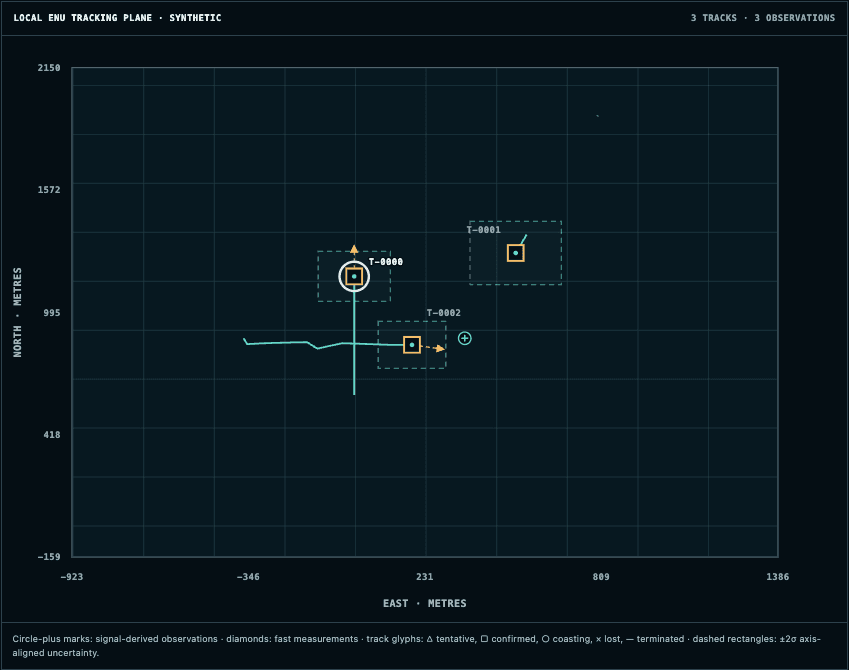
Fused tracks over time

Resolution fused-track view with confirmed synthetic tracks, current velocity and position uncertainty.
Actual fused-track view · synthetic observations and tracksView full size ↗

See how the air picture develops.

Resolution associates observations over time to maintain tracks. Operators can inspect track continuity, current motion and position uncertainty as the situation changes.

Actual product views · fictional scenario data

Australian capability development

Evaluate defence AI decision support for Australian capability development.

Resolution gives Defence, primes, sensor providers and research organisations a shared environment to define representative air and drone-defence scenarios, evaluate specialist model inputs and compare decision behaviour under matched conditions.

The design provides synthetic adapter contracts for exploring how radar, RF, EO/IR, counter-UAS and broader command-system readiness could change the decision. Any operational connection remains a separate technical and authority activity.

ASCA's Decision Advantage activity identifies automated data integration and interpretation, machine reasoning, multi-modal data fusion, augmented human-machine reasoning, AI agents and AI orchestration as priority technology areas. These subjects provide a useful context for evaluating Resolution's synthetic decision workflow. Read the ASCA Decision Advantage priorities

For a structured evaluation discussion, work through the evidence, human–machine teaming and test-and-evaluation questions in our Australian defence AI decision-support guide.

Evaluate Resolution against the decisions that matter to your mission.

We can work with Defence, industry and research teams to define representative scenarios, success measures and integration requirements for a controlled technical evaluation.