Project risk · Major infrastructure
ToM Assurance Suite
Connect requirements, drawings, interfaces, and evidence in one project record. See what has changed, understand the risk, and focus specialist judgement where it matters.
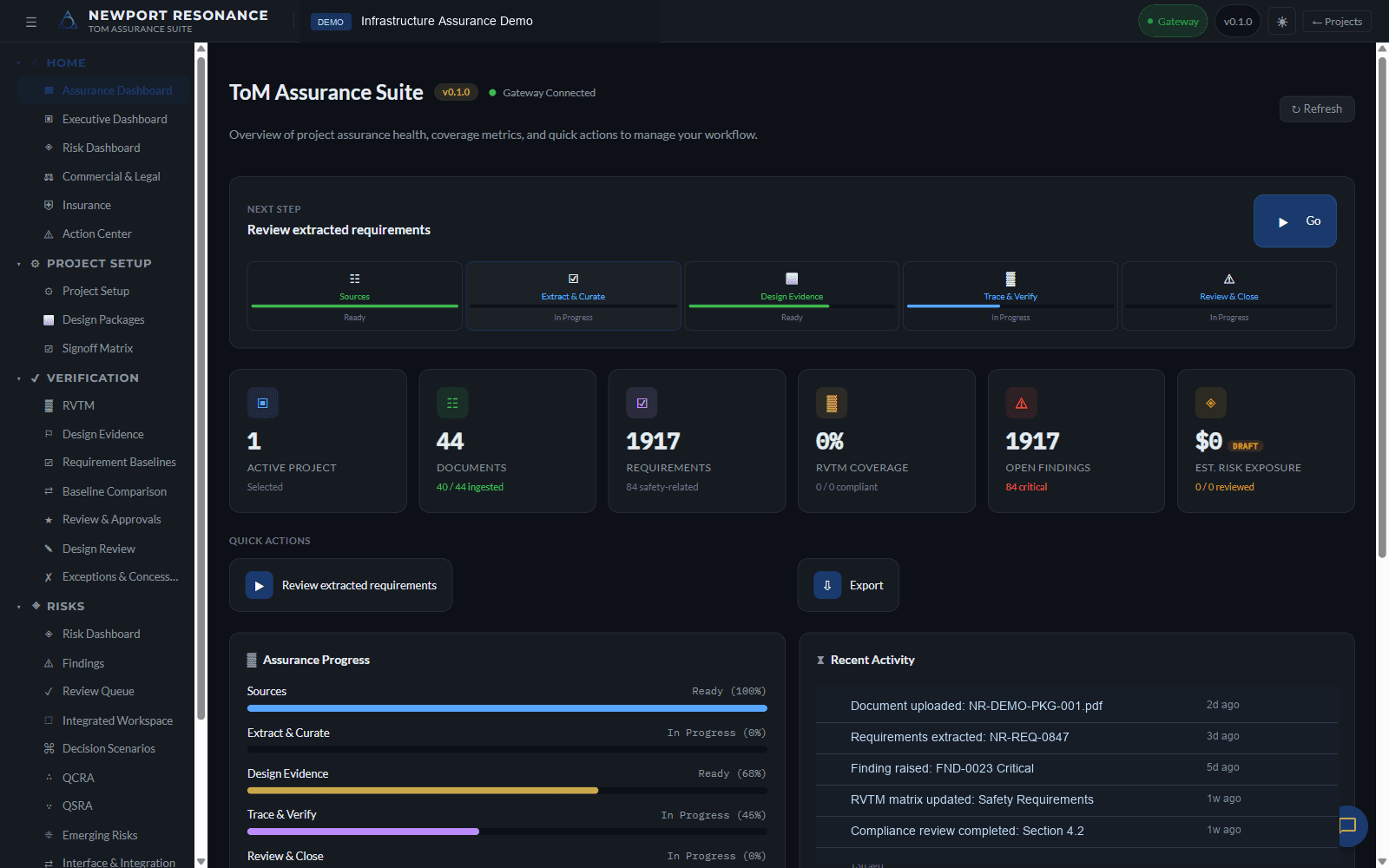
Real ToM Assurance Suite project dashboard, captured from the local product UI.
The buyer problem
See what a design change puts at risk.
AI construction document review needs to connect a finding to its consequences. Follow changed drawings and specifications into affected interfaces, delivery assumptions and the decisions that need attention.
Changes carry hidden consequences
A revised drawing can affect another package, a delivery assumption or an earlier review decision. The consequences need a current source basis and an owner.
Proof is fragmented
The obligation, design response, test record, reviewer decision, and current report often sit in different systems and spreadsheets.
Progress can hide weak evidence
A linked file does not prove that the evidence is current, relevant, phase-appropriate, or sufficient for the requirement.
Teams reconstruct the story
Specialists lose time rebuilding the source chain for reviews, gates, interfaces, reports, and audits instead of resolving the exceptions.
The operating change
One connected assurance record.
ToM Assurance is designed to sit above the project systems that already hold the proof. It preserves source context and review state as information moves from intake to decision.
01
Establish the governing baseline
Bring contracts, specifications, standards, third-party obligations, registers, drawings, and reports into a source-aware project record.
02
Connect obligations to evidence
Link requirements to design responses, drawing regions, calculations, test records, interfaces, findings, and reviewer decisions.
03
Focus review on the exceptions
Surface weak requirements, stale references, missing proof, interface pressure, and review blockers with their source basis intact.
04
Carry the decision record forward
Use the same connected assurance state for dashboards, RVTMs, review packs, reports, and project-grounded questions.
Product proof
See the connected record in practice.
These live product surfaces show how the same assurance record supports source intake, requirements review, drawing and interface assessment, prioritised work, and project-grounded questions.
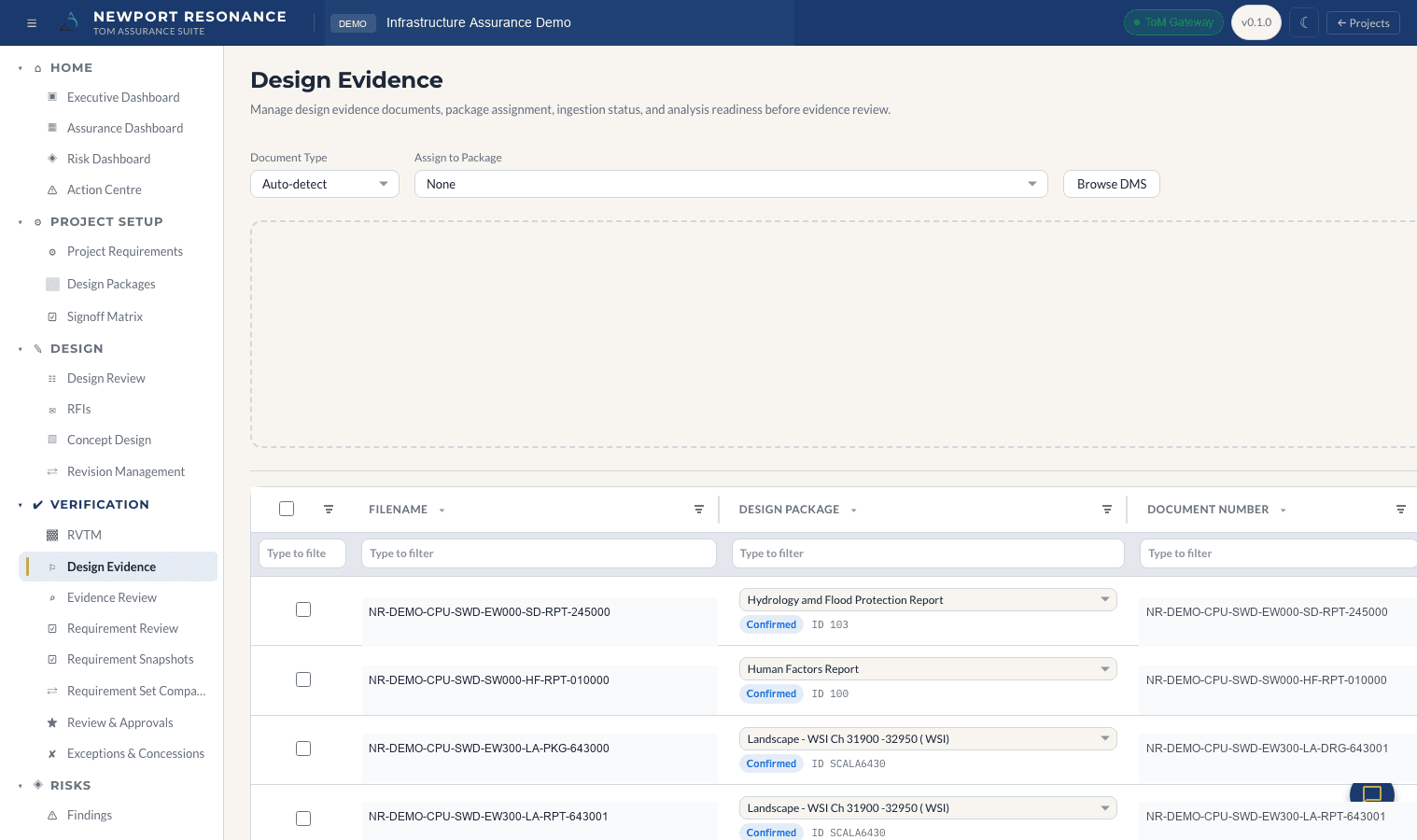
DMS and source intake
Connect the systems that hold the proof.
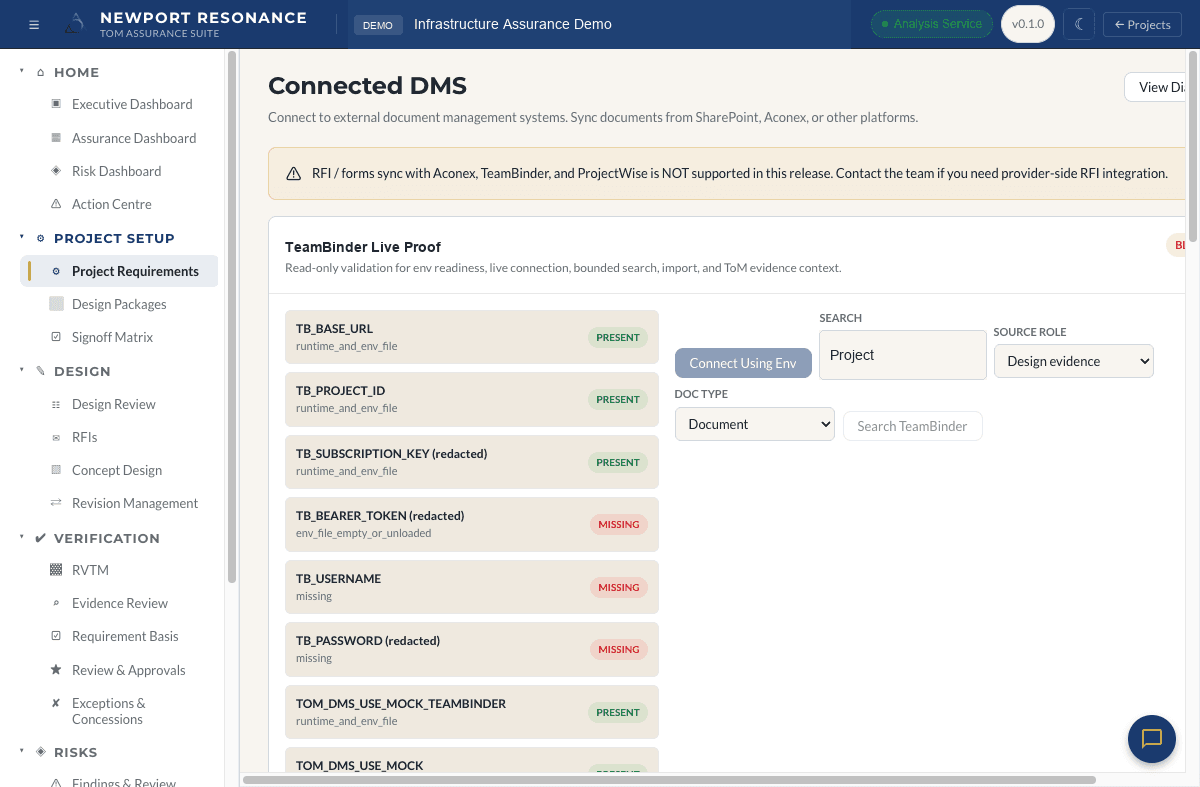
Assurance evidence usually lives in document platforms, not in a single requirements tool. ToM Assurance is built around API-led source intake, provenance capture, and document management workflows, with TeamBinder live-proof and connector patterns for ProjectWise and Aconex-style environments.
- Ingest source material with document identity, role, package, and project context preserved.
- Track readiness for TeamBinder-style API connections and DMS import workflows.
- Keep source provenance visible from requirement extraction through evidence review.
Requirements intelligence
Turn contracts and specifications into a governed baseline.
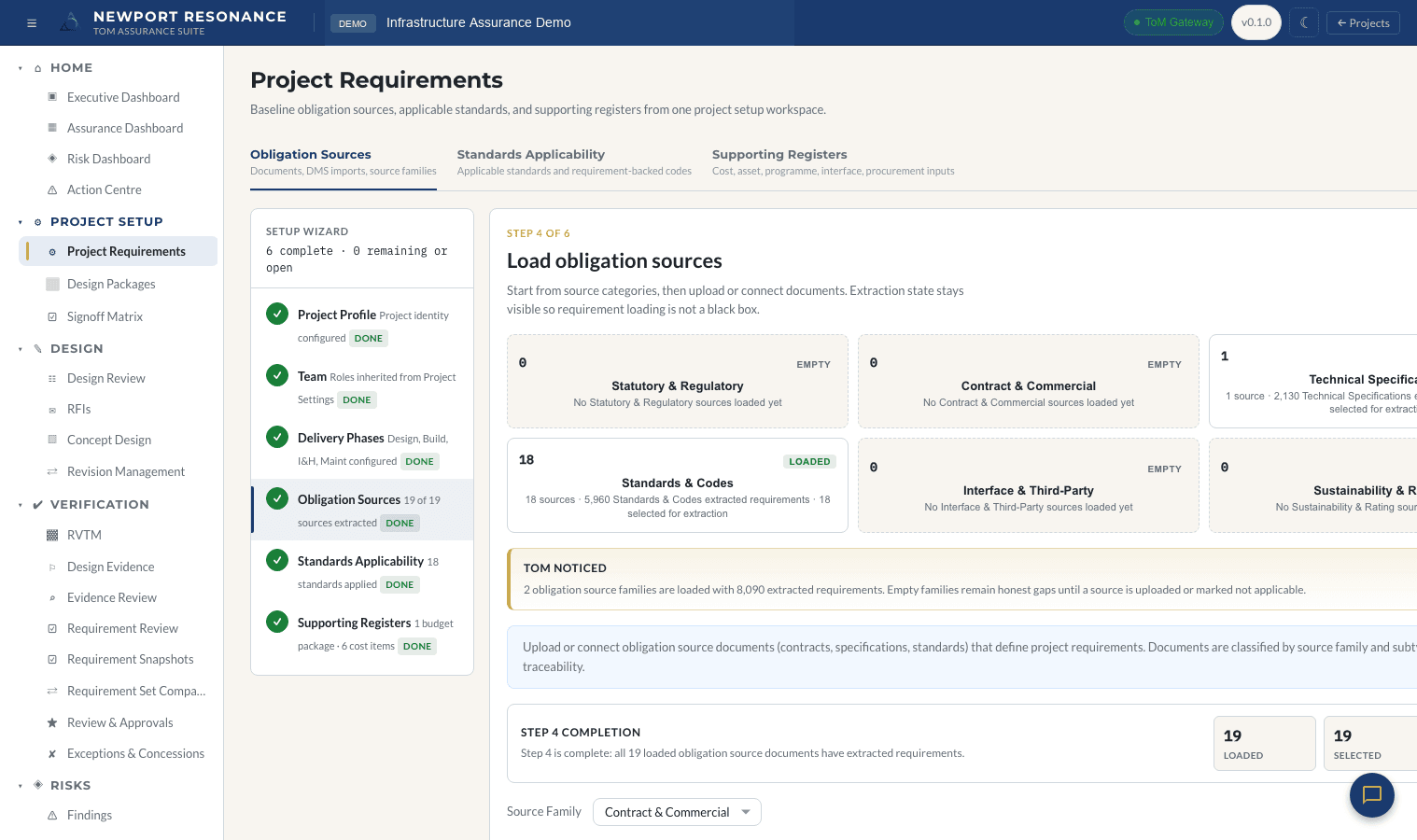
ToM Assurance does not stop at extracting clauses. It classifies source families, applies standards context, exposes gaps, and keeps human review in the loop before requirements become the project baseline.
- Load contracts, technical specifications, standards, registers, and interface sources by family.
- Review extracted obligations for ambiguity, missing acceptance criteria, and weak verification logic.
- Preserve a clear path from source clause to requirement, review state, and evidence need.
Interface and contract risk
Review interfaces before they become disputes.
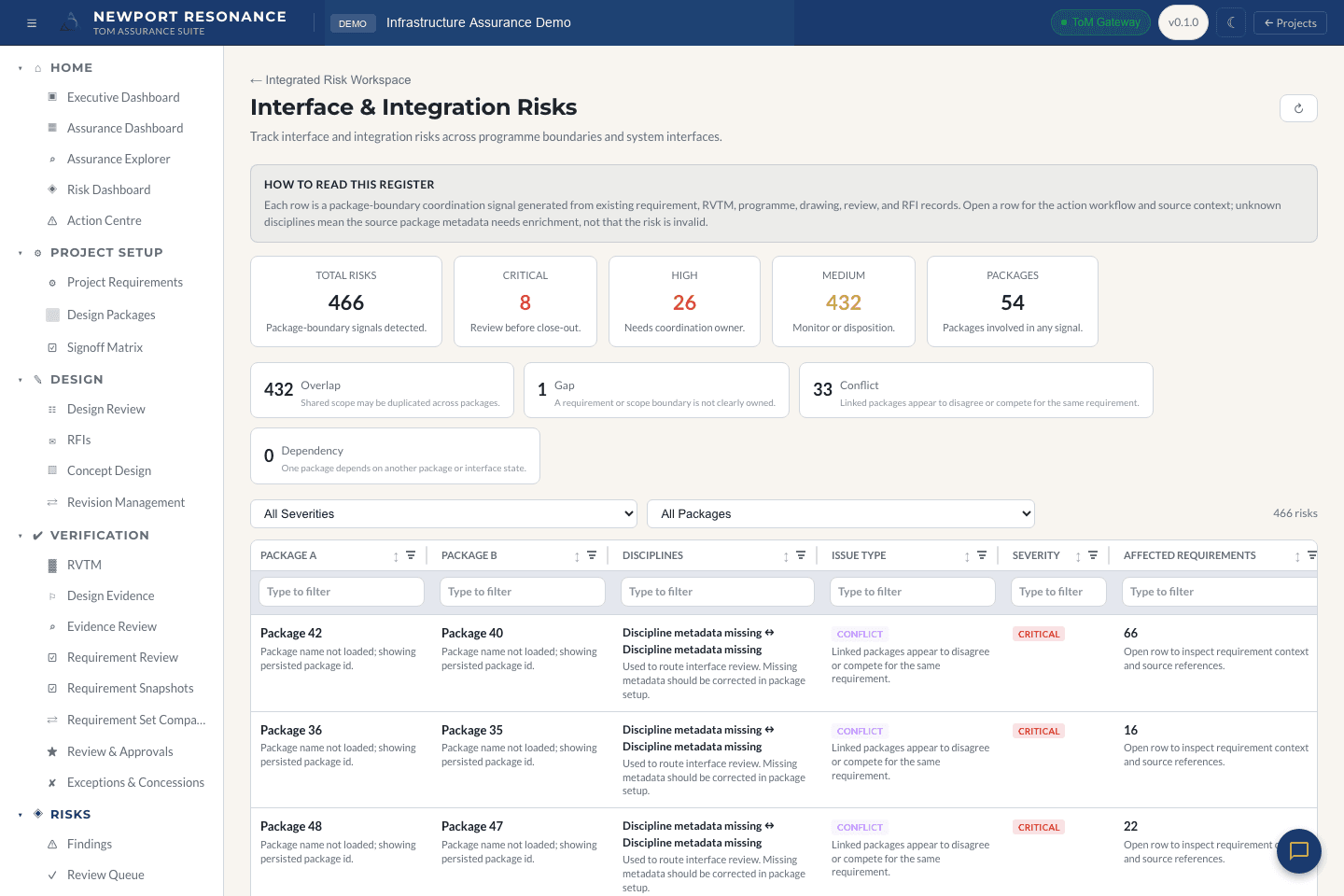
Complex projects fail at the boundaries between packages, disciplines, contracts, and systems. ToM Assurance surfaces interface overlaps, gaps, conflicts, dependencies, and affected requirements so teams can resolve risk while there is still time to act.
- Assess package-to-package and discipline-to-discipline interface risk.
- Track contractual interface obligations, affected requirements, and review ownership.
- Support formal notices and commercial workflows without separating them from assurance evidence.
Drawing assurance
Review the relevant drawings, not every sheet manually.
ToM Assurance inventories complete drawing packages, links requirements to likely sheets and regions, and selectively analyses the material most relevant to each obligation. It helps assurance teams focus review where it matters instead of manually examining every drawing.
- Read engineering drawings using bounded native-text, OCR, geometry, and multimodal analysis where each method is appropriate.
- Present source-grounded support, contradiction, or insufficient-evidence candidates against the requirement.
- Keep candidates traceable and reviewable; they do not become compliance truth automatically.
ToM Initiative
Let the platform surface the next assurance move.
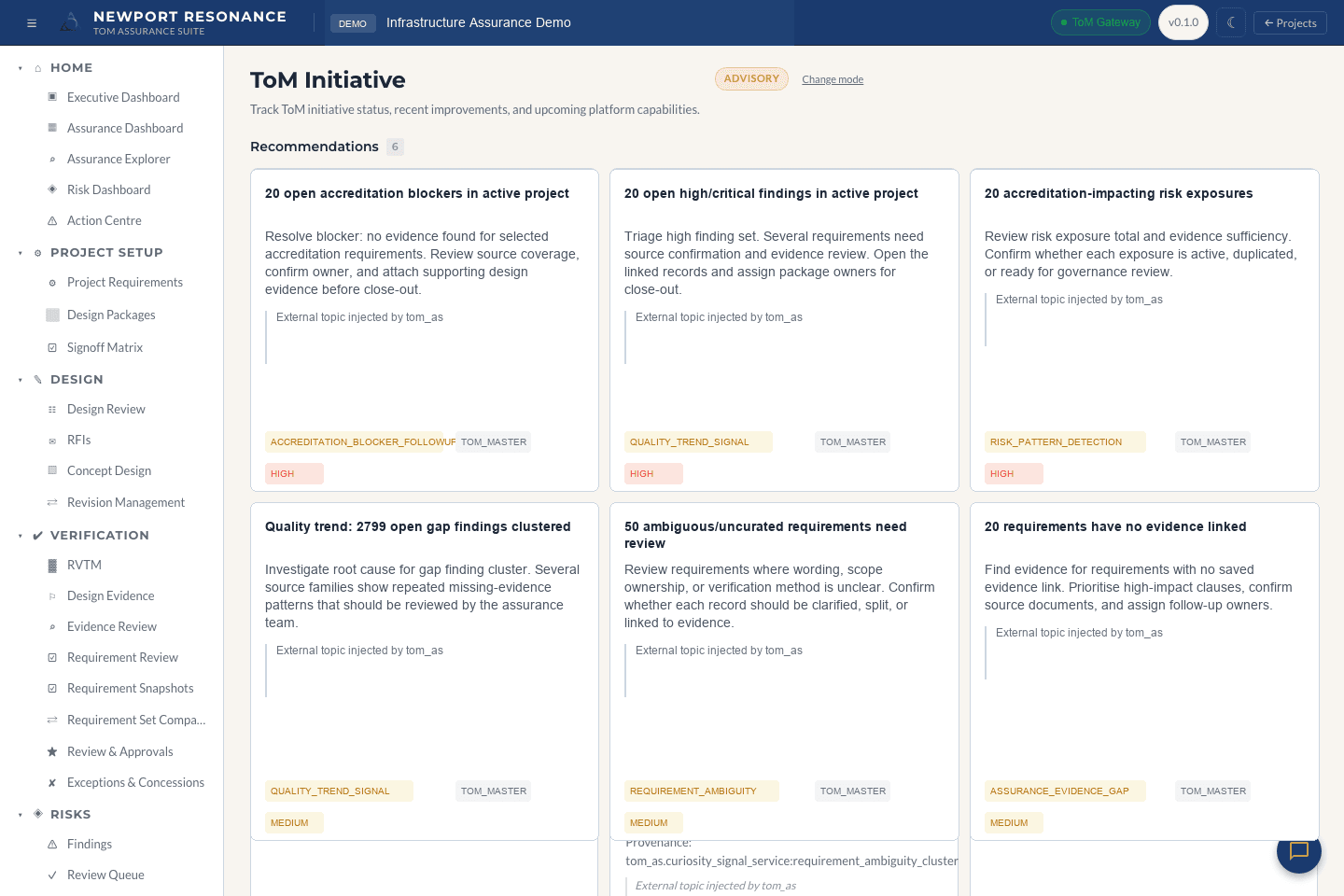
ToM Initiative turns the platform from a passive dashboard into an advisory operating layer. It identifies blockers, trend signals, evidence gaps, quality issues, and risk exposures, then proposes the next review action with provenance.
- Prioritise accreditation blockers, high-severity findings, evidence gaps, and quality trends.
- Show why a recommendation exists, which service raised it, and how urgent it is.
- Support advisory mode today while preserving a path to controlled action workflows.
Ask ToM
Ask questions about the project, not just the page.
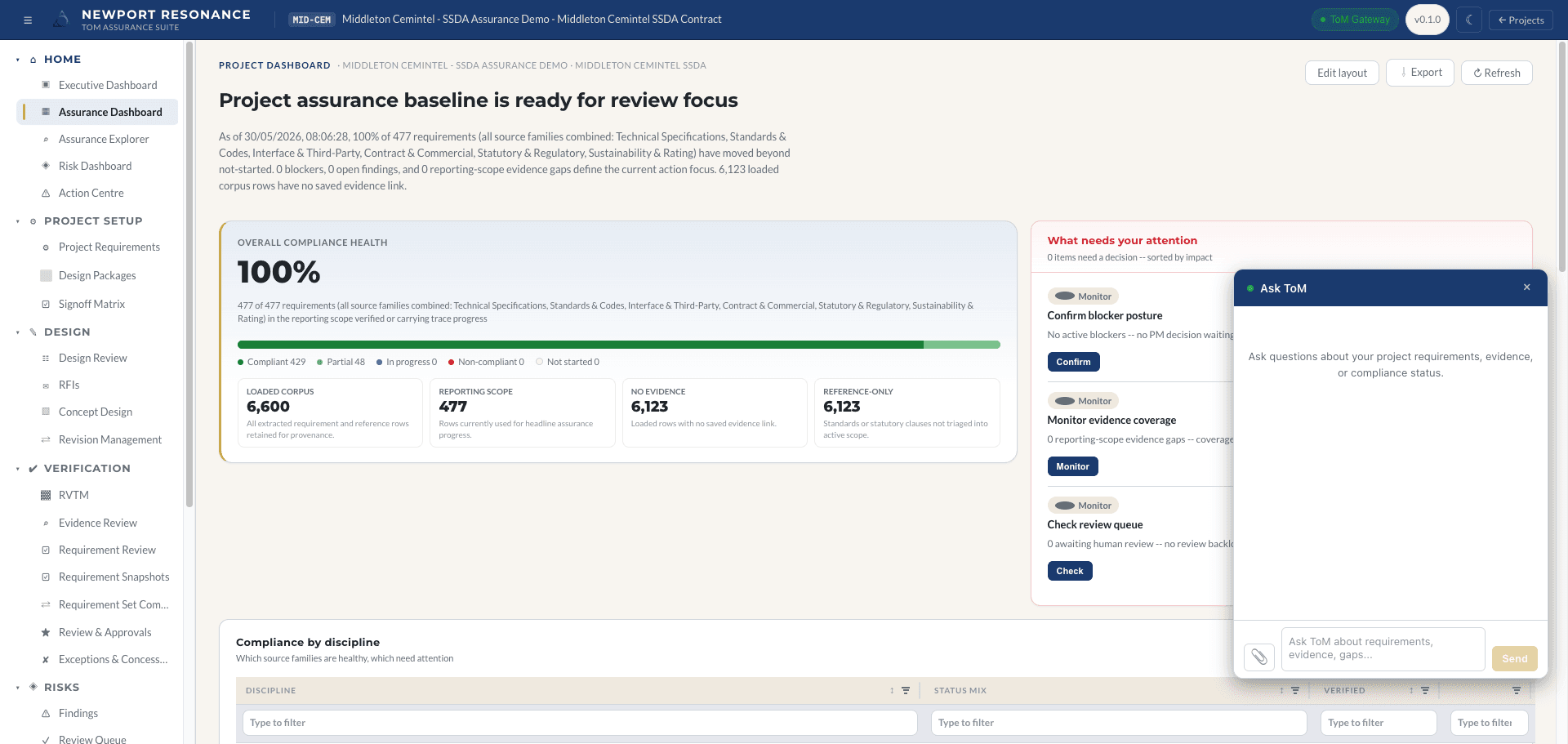
The ToM chatbot gives project teams a governed way to interrogate requirements, evidence, gaps, and compliance status. Answers stay tied to the project baseline and visible assurance context.
- Ask about requirements, evidence coverage, compliance gaps, and review status.
- Keep answers tied to the project baseline and visible assurance context.
- Give engineers and reviewers a faster route into the evidence trail.
Buyer outcomes
Move specialist effort from collation to judgement.
The value is a clearer assurance position before a gate, review, interface decision, or audit—not another disconnected document-processing tool.
Earlier review of assurance gaps
Bring weak evidence, stale traceability, unresolved interfaces, and gate blockers into view while the project team can still investigate and respond.
Less manual reconstruction
Give assurance specialists a connected source chain and focused review queue instead of asking them to rebuild the same relationships across files and registers.
Stronger review and audit readiness
Keep the requirement, source, evidence state, caveats, reviewer decision, and open risk together when a pack or report is prepared.
Start with a bounded value case
Prove the workflow on a decision that matters.
A first engagement can use a contained source pack and one assurance pressure, then expand by discipline, package, project, or enterprise model once the workflow is established.
Design-change impact review
Follow one proposed change through affected drawings, specifications, interfaces and evidence to identify the project decisions that need another look.
Drawing and specification review
Review a selected design package against its governing documents, with source-linked findings, unresolved questions and clear reviewer ownership.
Pre-issue or AFC gate review
Focus on the obligations, drawings, and evidence that matter to a defined design gate before the review pack is issued.
Interface and review-pack assessment
Use a selected interface set or assurance report to connect obligations, affected packages, missing information, and reviewer actions.
Product overview
Take the assurance story into your next project conversation.
Download the public ToM Assurance Suite overview for the buyer problem, connected operating model, representative product workflows, engagement paths, and review boundaries in one concise document.
Capabilities and deployment scope depend on configured data sources, integrations, and review controls.
Designed for
- Rail and infrastructure assurance teams
- Systems engineering and verification leads
- Programme directors managing regulated delivery risk
- Compliance, safety, and audit reviewers
Turn Assurance Into a Managed System
Bring a bounded source pack and the assurance decision that matters. We can show how ToM connects the requirement, the evidence, the review state, and the next action.
Project review and design-change guides
Use these workflows to connect project obligations to evidence and assess what a design change affects.