Salesforce deal intelligence
ToM Salesforce
Sales teams lose context every quarter: why confidence changed, why blockers escalated, and which precedent actually mattered. ToM Salesforce turns deal history into governed pipeline memory.
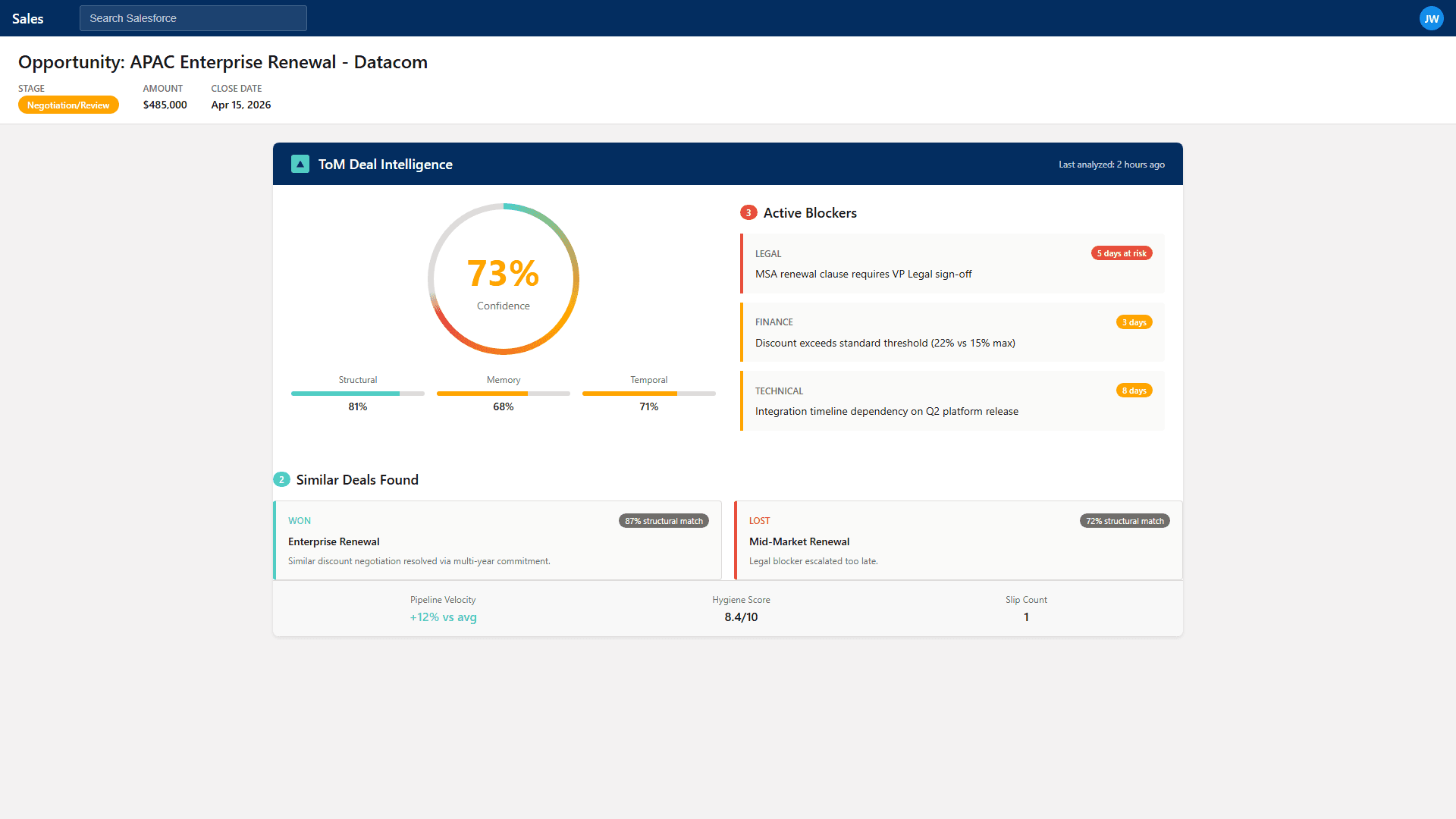
Salesforce opportunity surface with ToM deal intelligence embedded into the seller workflow.
Inspect the Salesforce Product Surface
Move through opportunity context, confidence and blockers, and precedent memory without repeating the same product frame.
Product surface 01
Keep intelligence inside the seller workflow.
Deal memory and current signals sit beside the Salesforce opportunity record instead of moving the team into a separate workspace.
The surface is advisory: it exposes a basis for review without silently rewriting CRM data.
Product film
See governed deal intelligence in Salesforce.
A five-minute walkthrough connects opportunity context, confidence, blockers, institutional memory, portfolio risk and the governed metadata boundary.
Read the complete film transcript
- 01
Opening Organisations don't forget because they want to. They forget because existing systems don't remember. This is ToM for Salesforce.
- 02
The enterprise problem Enterprise decisions can be complex. The reality of operations and deals includes conflicting goals, institutional memory loss — such as why decisions were made — and non-deterministic drivers such as stakeholder sentiment or reputational risk. AI agents execute configured tasks or algorithmic loops, but they don't remember what happened before, or the complexity of previous deals. Salesforce researchers know that multi-step interactions with LLMs fail to maintain context for decisions. This results in repeated internal escalation loops — the same approval rejections, legal deadlocks, and cross-functional rework cycling through Sales, Legal, and Finance — along with duplicated configuration and declining trust in AI recommendations.
- 03
The cognitive control plane ToM is not another AI agent. It's the cognitive control plane — an intelligent memory layer that governs what your AI tools and human decision-makers need to know. ToM works alongside Agentforce and other agentic tools. It doesn't replace execution — it governs memory, conflict arbitration, and escalation — providing a pathway for existing agents to continue autonomous actions when correct outcomes depend on judgement, politics, or emotion. ToM adds value as an Enterprise Deal and Account Intelligence system, working in the space where Sales, Legal, Finance, Service, and executives converge — offering clear economic outcomes: improved win rates, faster deal cycles, reduced internal approval friction, and lower attrition risk.
- 04
Institutional memory in action What you're seeing now is the demo product running in Salesforce today — a narrower AppExchange deployment proving value using a limited Salesforce API surface. On any Opportunity, the Memory Panel loads automatically. You see confidence decomposed into transparent dimensions you can reason about — structural readiness, historical patterns, temporal signals. The app calculates deal confidence using intelligent weightings of historical deal patterns. The more deals your organization completes, the more accurate that confidence becomes — enabling more accurate financial forecasting over time. But it's not just enterprise deal history that goes into the deal confidence scores. ToM uses more recent context such as stakeholder engagement signals, deal stage progression, and sales person track records to make forecasts as accurate as possible. Below, it surfaces similar past deals — showing what the organization learned from those situations. This is institutional memory in action, helping organisations to improve — not just report.
- 05
Conflict detection and escalation The current demo app detects active blockers and classifies each one by the responsible lane — Legal, Finance, Executive. The conflicts are detected from two primary sources: lessons learned from historical deals, and external connections via Contract Lifecycle Management, Enterprise Resource Planning, and Support. The app follows a clear action flow: detect the conflict, classify the lane owner, estimate time-risk based on historical resolution times, and route to the next action surface. Click on a legal conflict, and you're taken directly to where the issue can be addressed. When there's context that only a human would know — a stakeholder change, a political dynamic — the escalation modal captures it in a structured way. This creates the pathway for increasingly automated resolution over time, with humans always in control and decision logic auditable.
- 06
Portfolio and governed metadata For managers, the app provides a Portfolio Dashboard that shows the full pipeline at a glance. Filter by risk tier to see which deals need attention this week. ToM operates in a governed zero-copy metadata mode. Salesforce remains the system of record; only banded signals and pseudonymous identifiers cross the boundary. No raw customer content is copied or retained. Every recommendation and escalation is auditable, and decision guardrails are configurable by admins.
- 07
Why it matters The value is compounding. More accurate forecasting — because confidence improves with every deal. Conflicts resolved before they derail timelines. And institutional memory that stays with the organization — not in someone's head. Every deal benefits from every deal that came before it.
- 08
Closing The demo proves value now. Funding accelerates the ultimate platform — across clouds, across orgs, and into governed automation. Today, Sales Cloud. Tomorrow, multi-cloud federation across Service, Commerce, and Industry. From advisory mode to configurable engagement. This is just the beginning. The institutional memory that makes every deal smarter. ToM for Salesforce.
“Governed zero-copy metadata mode” describes ToM's default application boundary; it is not Salesforce Data 360 Zero Copy federation. The captured org uses demo fallback data and does not itself prove deployment of the newer Apex boundary. Production pseudonymization requires protected, rotatable per-org key material and deployment-specific verification. Product outcomes and connector patterns described in the film are intended capabilities, not measured customer results or proof that those connectors are configured in the captured org.
From CRM Records to Deal Reasoning
Turn opportunity records into governed forecast reasoning, institutional memory, and earlier escalation awareness.
Deal memory
Surface relevant precedent from similar opportunities so reps and managers can see what worked, what failed, and why.
Confidence decomposition
Break forecast confidence into structural completeness, historical precedent, stage velocity, and escalation risk.
Escalation context
Capture blockers, political dynamics, stakeholder changes, and time-risk signals before they disappear into call notes.
Portfolio risk view
Give sales leadership a governed view of risk patterns across deals, not just stage-weighted pipeline totals.
Advise Without Rewriting Your CRM
ToM Salesforce adds a read-only advisory layer to the seller workflow. It explains the signals behind its guidance, keeps advice bounded to available deal evidence, and leaves forecast and commercial judgement with your team.
- Read-only advisory layer for Salesforce Sales Cloud
- Designed to preserve CRM workflows rather than replace them
- Insights are tied to signals and precedent, not unsupported certainty
- Forecast and commercial judgement remain with the sales team
Give Your Pipeline a Memory
Use ToM Salesforce to preserve deal context, explain forecast changes, and surface precedent before risk becomes surprise.